How to vet a receiving agent for a referral, a simple scorecard (reviews, production, response time, niche fit)
A referral can feel simple, until it doesn’t. Your client is trusting you to pick the right pro in another market, and your name stays attached to that choice long after you’ve handed the client off.
If you’re a Referral-Only Real Estate Agent , you also don’t get the “second chance” that comes from being in the transaction every day. That’s why it helps to vet receiving agents the same way every time, with a short process and a simple scoring system you can defend.
Below is a practical real estate referral scorecard you can use in February 2026 and beyond, plus scripts and compliance basics to keep your referrals clean.
Start with compliance basics (license, brokerage, agreement, privacy)
Before you look at reviews or production, confirm the receiving agent is legally able to perform the work, and that your referral paperwork is tight. Think of this like checking the foundation before you tour the kitchen.
Confirm active license and current brokerage affiliation
Ask for the agent’s full name, license number, and current brokerage name, then verify it yourself on the state’s official lookup.
Use the receiving agent’s state licensing site (or the state’s licensing umbrella site) rather than trusting a screenshot. Examples:
- California: California’s real estate license verification
- Michigan: Michigan LARA license and business lookup
Also confirm the agent is properly affiliated with a brokerage that can accept and pay referrals in that state. If the state lookup doesn’t clearly show affiliation, ask the agent for their broker-of-record contact, then verify by calling the brokerage main line.
Use a written referral agreement with clear terms
Even if you’ve known the agent for years, put it in writing. At a minimum, your agreement should spell out:
- Referral fee percentage and what it’s based on (gross commission, net commission, side-specific)
- When the fee is earned (closing, funding, recorded deed, etc., depending on local practice)
- Who pays the fee (receiving brokerage to your brokerage)
- Protected period (how long the client is tied to the referral)
- What happens if the client switches agents within the same brokerage
- Who will provide closing statements or proof needed for payment
If you’re placing your license with a referral brokerage, keep your process consistent with your broker’s requirements. If you need a quick refresher on how a referral-only model works, point newer partners to Direct Connect Brokerage FAQs.
Keep client data tight (privacy and minimum necessary)
Send only what the receiving agent needs to serve the client. Usually that’s contact info, timeline, price range, and key constraints. Avoid oversharing sensitive items (financial docs, IDs, medical info, divorce details). Use secure email, and don’t CC too many people.
Use the weighted real estate referral scorecard (simple, repeatable, defensible)
A good vetting method should work when you’re busy, tired, or handling multiple markets. The goal isn’t perfection, it’s consistency.
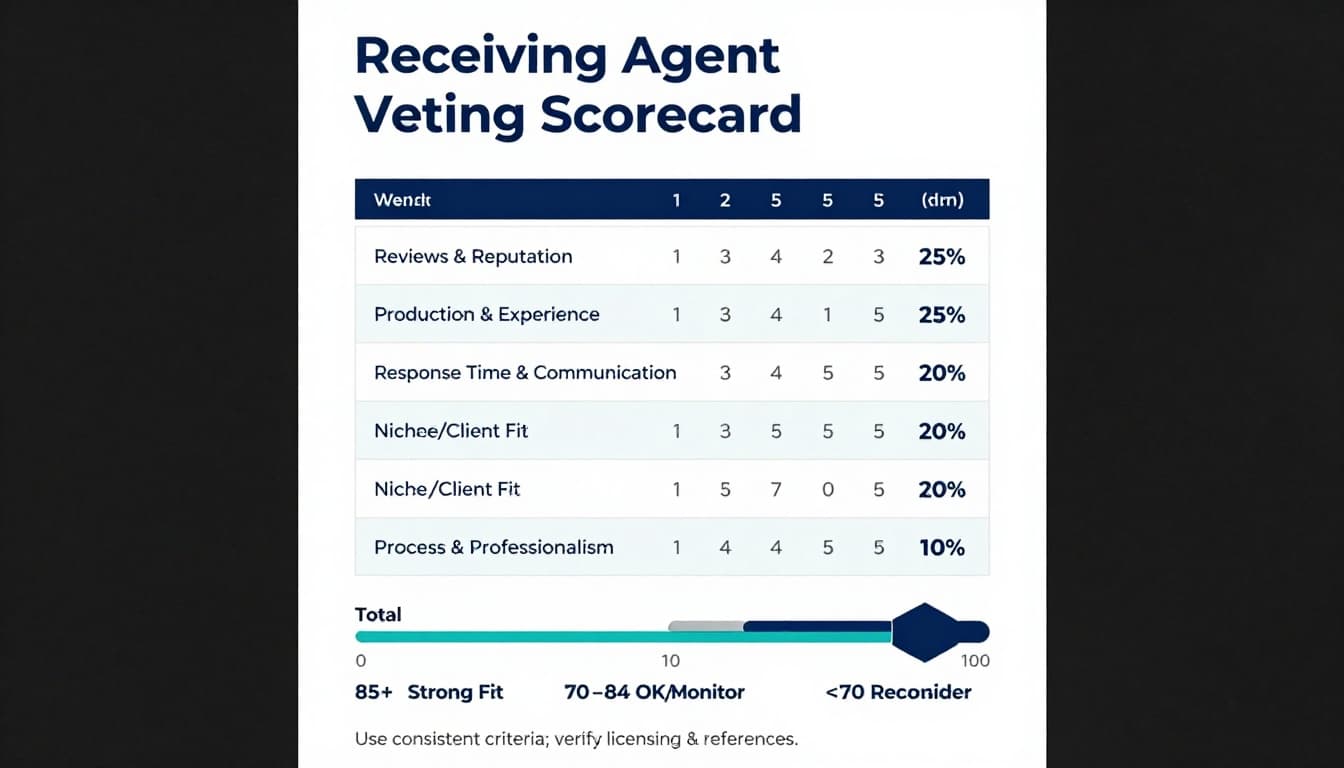
An at-a-glance scorecard layout showing the same weighted criteria below, created with AI.

Use this table as your working template. Score each category from 1 to 5. Then compute Weighted Total as: (Score ÷ 5) × Weight. Example: Score 4 on a 25% category equals 20 points.
| Criteria | What to verify | Questions to ask | Weight (points) | Score (1–5) | Weighted total |
|---|---|---|---|---|---|
| Reviews & reputation | Pattern of recent reviews, complaint signals, professionalism in responses (Google Business Profile, major portals, local community pages) | “Any recent client issues I should know about, and how did you resolve them?” | 25 | ||
| Production & experience | Recent closed sides/volume, years active, MLS summary (when available), transaction mix like buyer vs seller | “How many closings in the last 12 months, and what price bands?” | 25 | ||
| Response time & communication | Speed of initial reply, clarity, proactive updates, weekend coverage plan | “What’s your update cadence, and who covers if you’re offline?” | 20 | ||
| Niche and client fit | Experience with the client type (relocation, VA, luxury, investor, new build, condos), local knowledge | “What’s a recent deal like this one, and what went wrong?” | 20 | ||
| Process & professionalism | Intake process, showing plan, lender coordination, written timelines, use of assistants, clean handoff | “Walk me through your first 7 days with my client.” | 10 |
A note on “production”: you’re not trying to crown the top agent in town. You’re trying to avoid the agent who’s inactive, disorganized, or stretched too thin. Ask for numbers, but also listen for confident, plain-English answers.
Decision rule: how to interpret the total score
Add the weighted totals to get a score out of 100.
- 85 to 100 : Strong fit, send the referral (still get it in writing).
- 70 to 84 : OK, send only if the client situation is lower risk, then monitor closely.
- Below 70 : Reconsider, get another option, or re-route to a better match.
If two agents are close in score, break the tie with response time and niche fit. Your client feels communication problems fast.
Request proof fast (call script + email template you can copy)
A receiving agent reviewing a referral score and notes at a home office desk, created with AI.

Most agents will sound great in a quick chat. Your job is to get a few facts, quickly, without making it awkward. Treat it like verifying a contractor bid: friendly tone, clear asks, no rambling.
Short call script (3 to 5 minutes)
You: “Hi [Name], I’m sending a client to [City]. I run referrals only, so I’m picky because my name stays on it. Mind if I ask a few quick things to confirm fit?”
You: “What’s your typical response time, and what’s your plan for evenings and weekends?”
You: “How many closings did you personally close in the last 12 months, and what price range do you do most?”
You: “Have you worked with [client niche: relocation, VA, investor, luxury, first-time] in the last year? Tell me one example and how you handled bumps.”
You: “What happens in your first week after intake? Do you send a written timeline?”
You: “Last thing, I’ll need your license number and brokerage details for the referral agreement. What email should I send it to?”
Then stop talking. Let them answer. Agents who can’t explain their process in plain language tend to run messy files.
Email template to request stats, availability, and niche experience
Subject: Referral request for [City] client, quick fit check
Hi [Agent Name],
I have a [buyer/seller] referral for [City/area]. Timeline is [timeframe], price range is [range], and key needs are [2–3 bullets in one sentence].
Before I send the client over, can you reply with:
- Your license number and current brokerage (for verification and the referral agreement)
- Your last 12-month production (closed sides and main price bands)
- Your experience with [niche] (one recent example is perfect)
- Your availability plan (response time, weekend coverage, assistant/team support if any)
- The best intake process for you (intro call link, questions you want me to tee up)
If you’re a fit, I’ll send the referral agreement for signature and introduce you right away.
Thanks,
[Your Name]
[Your Brokerage]
[Phone]
Keep a simple paper trail
Save three items in your referral file: license verification screenshot or PDF, the signed referral agreement, and your scorecard. If you want a quick place to start finding agents to vet, use the Referral Agent Directory and run the same scorecard on any candidate.
Conclusion
The difference between a smooth referral and a painful one usually comes down to basics: verified licensing , clear communication, and niche fit. A consistent real estate referral scorecard keeps you honest, helps you explain your choice to a client, and protects your reputation when you’re not in the trenches of the transaction.
Pick your thresholds, document your checks, and don’t “hope” an agent will perform. Score it, confirm it, then send it.
Recent Posts